
Introduction
SEO has changed a lot over the years. In the past, many websites tried to rank by repeating the same keyword again and again. If a page was targeting “best SEO tools,” like Seotoolsgroupbuy.us the writer would use that exact phrase in the title, headings, first paragraph, image alt text, and many times throughout the content.
That approach no longer works the same way.
Search engines are now much better at understanding meaning, context, user intent, and relationships between topics. This is where semantic SEO becomes important.
Semantic SEO is the process of creating content around complete topics instead of only focusing on single keywords. It helps search engines understand what your content is about, how deeply it covers a subject, and whether it answers the real questions users have.
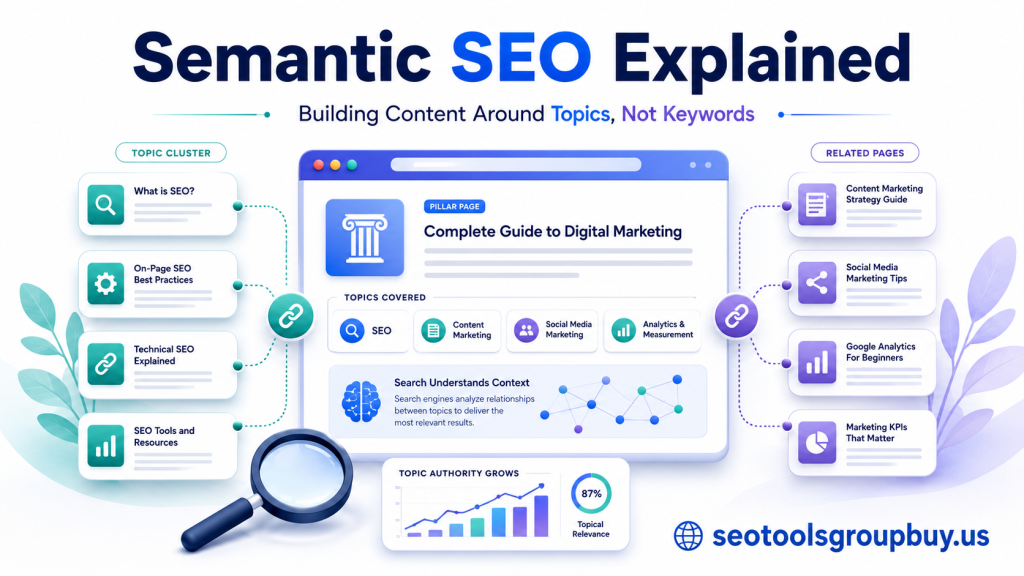
Instead of writing one page for one keyword, semantic SEO encourages you to build useful content around a full topic. This includes related subtopics, questions, examples, definitions, comparisons, and internal links that connect everything together.
For example, a basic keyword-focused page may target “link building.” But a semantic SEO strategy would also cover backlinks, anchor text, outreach, digital PR, broken link building, backlink quality, referring domains, link audits, and link building mistakes. This gives search engines and users a much clearer understanding of your expertise.
In this guide, you will learn what semantic SEO is, why it matters, how it works, and how to create topic-based content that performs better in search results.
What Is Semantic SEO?
Semantic SEO means optimizing content based on meaning, context, and topic relationships instead of only using exact-match keywords.
The word “semantic” refers to meaning. In SEO, it means helping search engines understand the meaning behind your content and the meaning behind a user’s search.
For example, someone searching for “how to build backlinks” may also be interested in:
- What backlinks are
- Why backlinks matter
- How to get high-quality backlinks
- What link building strategies work
- What anchor text is
- How to avoid spammy links
- How to analyze competitor backlinks
A semantic SEO article does not only repeat the keyword “how to build backlinks.” It answers the broader topic in a complete, helpful, and organized way.
Semantic SEO is about depth, relevance, and clarity. It helps your content become more useful because it covers the topic from different angles.
Semantic SEO vs. Traditional Keyword SEO
Traditional keyword SEO focuses mainly on individual keywords. The goal is to choose a target keyword and optimize one page around that exact keyword.
Semantic SEO goes further. It focuses on the complete topic behind the keyword.
Here is the difference:
Traditional keyword SEO asks:
- What keyword should this page target?
- How many times should I use the keyword?
- Can I add the keyword in the title and headings?
- What is the search volume of this keyword?
Semantic SEO asks:
- What is the user really trying to understand?
- What related questions should this page answer?
- What subtopics are necessary to cover the subject properly?
- What entities, terms, and concepts are connected to this topic?
- How does this page connect with other pages on the website?
- Does the content satisfy the full search intent?
Keyword research is still important. But keywords should guide your content, not control it. A strong SEO article should sound natural, cover the full topic, and answer the reader’s real problem.
Why Semantic SEO Matters
Semantic SEO matters because search engines want to show helpful and relevant results. A page that fully explains a topic is often more useful than a page that only repeats a keyword.
Here are the main reasons semantic SEO is important.
1. Search Engines Understand Context Better
Search engines do not only match words anymore. They look at the meaning of the page, the relationship between terms, and the intent behind a search query.
For example, Google can understand that “SEO tools,” “keyword research tools,” “rank tracking software,” and “backlink analysis tools” are connected topics. A website that explains these ideas clearly may appear more relevant than a page that only repeats one phrase.
2. Users Search in Different Ways
People do not always use the same words when searching. One person may search “semantic SEO,” another may search “topic-based SEO,” and another may search “how to build topical authority.”
All of these searches may have similar intent.
Semantic SEO helps you cover these variations naturally. Instead of creating separate thin pages for every keyword, you can build stronger content that answers the complete topic.
3. It Helps Build Topical Authority
Topical authority means your website is seen as a strong source of information about a specific subject.
If your site has one article about SEO, it may not be enough to show expertise. But if your site has detailed articles about keyword research, link building, technical SEO, semantic SEO, content optimization, SEO tools, site audits, and analytics, search engines can better understand your site’s topical focus.
Semantic SEO helps you build a full content ecosystem around your niche.
4. It Improves User Experience
A semantic SEO article is usually more helpful because it answers more questions. Readers do not have to visit many different websites to understand the topic.
When users find complete answers on your page, they are more likely to stay longer, read more sections, visit related pages, and trust your brand.
5. It Supports Long-Tail Keyword Rankings
A well-written semantic SEO article can rank for many related keywords, not just one.
For example, an article about “semantic SEO” may also rank for:
- semantic SEO meaning
- semantic SEO strategy
- topic-based SEO
- content clusters SEO
- topical authority SEO
- entity SEO
- how to optimize content for search intent
This can increase organic traffic because one strong page can attract visitors from many search queries.
How Search Intent Connects with Semantic SEO
Search intent is the reason behind a user’s search. To create strong semantic SEO content, you must understand what the user wants.
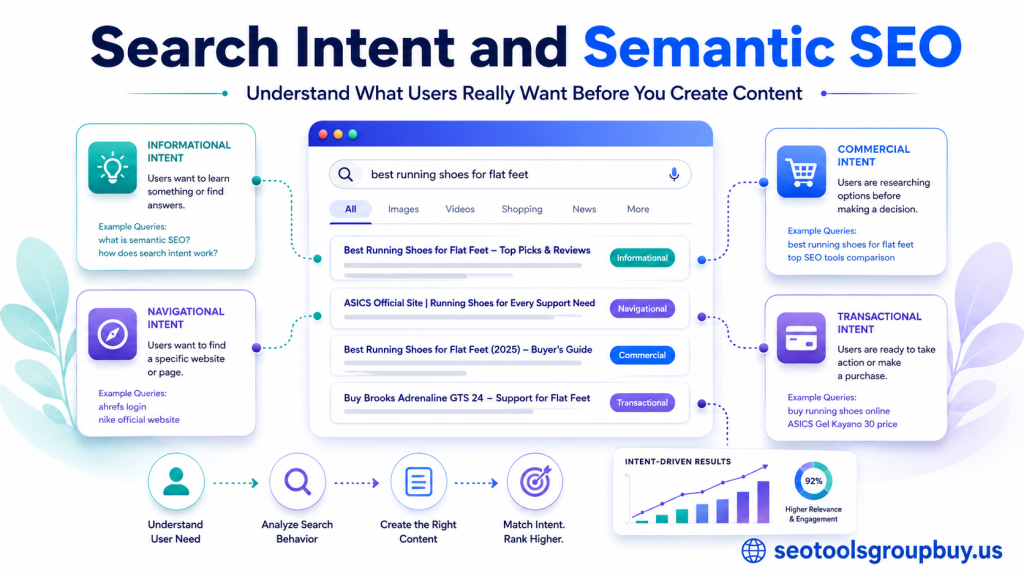
There are four common types of search intent.
1. Informational Intent
The user wants to learn something.
Examples:
- What is semantic SEO?
- How does topical authority work?
- What is keyword clustering?
For informational intent, your content should explain the topic clearly, answer common questions, and provide examples.
2. Navigational Intent
The user wants to find a specific website, brand, or page.
Examples:
- Semrush login
- Google Search Console
- seotoolsgroupbuy.us
For navigational intent, your page must match the brand or destination the user is looking for.
3. Commercial Intent
The user is researching before making a decision.
Examples:
- best SEO tools for keyword research
- Ahrefs vs Semrush
- best backlink checker tools
Users searching for affordable SEO tools may also compare keyword research tools, backlink checkers, rank trackers, and site audit platforms before choosing the right option.
For commercial intent, your content should compare options, explain benefits, and help users make a smart decision.
4. Transactional Intent
The user is ready to take action.
Examples:
- buy SEO tools
- subscribe to SEO software
- get backlink analysis tool
For transactional intent, your page should make the action clear and easy.
Semantic SEO works best when your content matches search intent. A page that answers the wrong intent will struggle, even if it uses the right keyword.
What Are Entities in Semantic SEO?
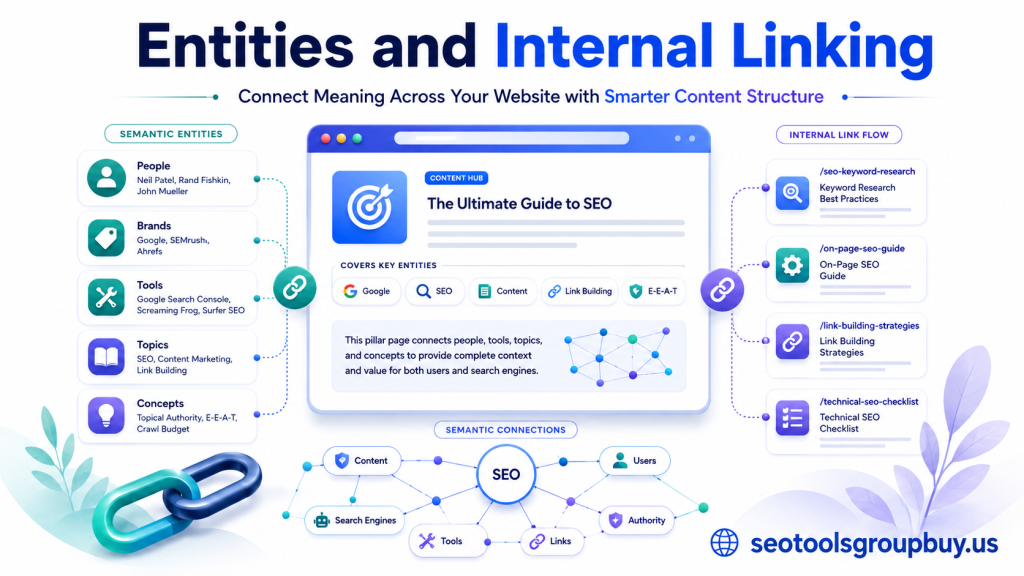
Entities are specific things that search engines can identify and understand. An entity can be a person, place, brand, product, concept, tool, organization, or topic.
In SEO, entities help search engines understand relationships.
For example, in the topic “semantic SEO,” related entities may include:
- Google Search
- Search intent
- Keywords
- Content clusters
- Topical authority
- Internal linking
- Natural language processing
- Structured data
- Search engine optimization
- User experience
When your content includes important related entities naturally, it becomes easier for search engines to understand the topic.
Entity SEO does not mean stuffing random terms into your content. It means covering the important ideas that belong to the topic.
For example, if you write about “technical SEO” but never mention crawling, indexing, site speed, robots.txt, XML sitemaps, canonical tags, or structured data, the content may feel incomplete.
The same applies to semantic SEO. To cover the topic properly, you should include related ideas such as search intent, topic clusters, entities, content depth, internal links, and topical authority.
What Is Topical Authority?
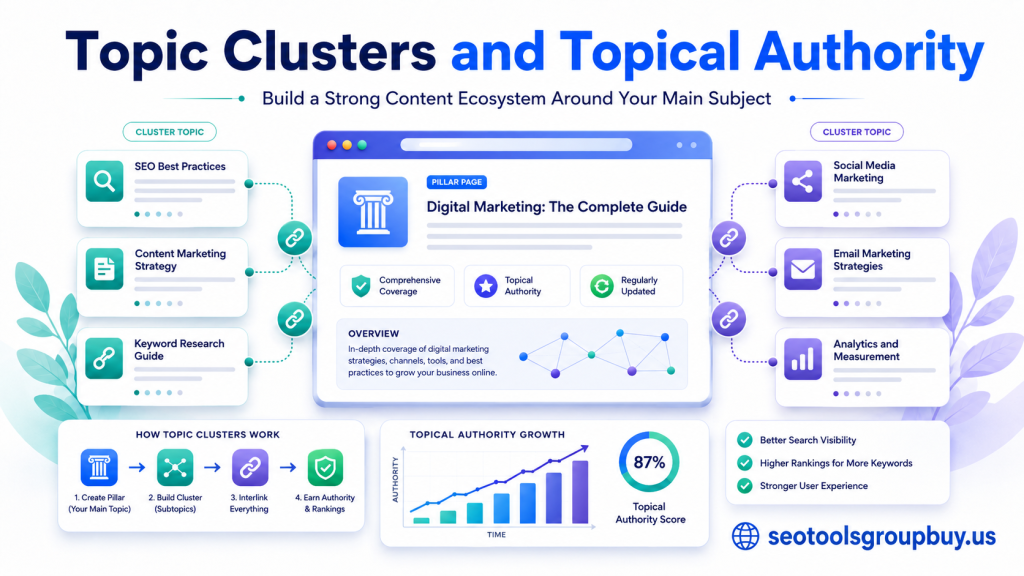
Topical authority means your website has strong coverage and expertise around a specific subject.
For example, if a website publishes many high-quality articles about SEO tools, keyword research, content marketing, backlinks, technical SEO, and Google Search Console, it can build topical authority in SEO.
A single page can rank, but a full topic cluster is stronger.
A topic cluster usually includes:
- A main pillar page
- Supporting blog posts
- Internal links between related pages
- Clear site structure
- Helpful content that answers user questions
For example, if your main topic is “SEO tools,” your content cluster may include:
- Best SEO tools for beginners
- Keyword research tools explained
- Backlink checker tools
- Rank tracking tools
- Site audit tools
- How to use SEO tools for content planning
- Free vs paid SEO tools
- SEO tools for small businesses
Together, these pages show that your website covers the topic in depth.
How to Build Content Around Topics, Not Keywords
Building content around topics requires a better planning process. Instead of starting with one keyword, start with the full subject.
Here is a practical step-by-step process.
Step 1: Choose a Main Topic
Start with a broad topic that matters to your audience and your business.
Examples:
- Semantic SEO
- Link building
- Keyword research
- Technical SEO
- SEO tools
- Content marketing
- Digital PR
- Website audits
Your main topic should be relevant to your services, products, or website niche.
For seotoolsgroupbuy.us, topics related to SEO tools, keyword research, backlink analysis, content optimization, and digital marketing software would make sense.
For brands like SEO Groups Buy, topics related to SEO tools, keyword research, backlink analysis, content optimization, and digital marketing software would make sense.
Step 2: Understand the Main Search Intent
Before writing, search your topic and study what users expect.
Ask:
- Are users looking for a beginner guide?
- Do they want a checklist?
- Are they comparing tools?
- Do they need examples?
- Are they ready to buy?
- Are they looking for definitions?
- Are they searching for a step-by-step process?
This helps you decide the content format.
For example, “semantic SEO explained” is informational. The article should teach the reader. But “best semantic SEO tools” is commercial. That article should compare tools and help users choose.
Step 3: Find Related Subtopics
A topic-based article should include important subtopics.
For semantic SEO, related subtopics include:
- Search intent
- Entities
- Topic clusters
- Keyword clustering
- Internal linking
- Content depth
- Topical authority
- Structured data
- Content optimization
- User experience
- FAQs
These subtopics help your article become more complete.
Step 4: Group Keywords by Meaning
Instead of writing one page for every keyword, group similar keywords together.
For example:
Keyword group 1:
- semantic SEO
- semantic SEO meaning
- what is semantic SEO
- semantic SEO explained
Keyword group 2:
- semantic SEO strategy
- how to do semantic SEO
- semantic SEO best practices
Keyword group 3:
- topic clusters SEO
- topical authority SEO
- content clusters SEO
Each group may become a section in one strong article or a separate supporting article if the topic is big enough.
Step 5: Create a Clear Content Structure
Good structure helps both users and search engines.
Use headings to organize your article naturally. A strong semantic SEO article should have:
- A clear title
- Short introduction
- Definition section
- Why it matters
- Main steps
- Examples
- Common mistakes
- Checklist
- FAQs
- Conclusion
Your headings should answer real user questions. Avoid vague headings like “More Information.” Use helpful headings like “How to Build a Topic Cluster” or “Common Semantic SEO Mistakes.”
Step 6: Answer Related Questions
Users often have follow-up questions. Answering them helps your content become more useful.
For example, in an article about semantic SEO, users may ask:
- Is semantic SEO the same as keyword SEO?
- Do keywords still matter?
- How do I find related topics?
- What is a topic cluster?
- How many internal links should I add?
- How long should semantic SEO content be?
- Can semantic SEO improve rankings?
Add a FAQ section near the end of your article to answer these questions clearly.
Step 7: Use Internal Linking
Internal links are very important for semantic SEO. They connect related pages and help search engines understand your site structure.
For example, from this article, you could link to:
- Link Building for SEO
- Best SEO Tools
- Keyword Research Guide
- Backlink Analysis Guide
- Technical SEO Checklist
- Content Optimization Tips
Internal links also help users move from one useful page to another.
A good internal link should use natural anchor text. For example:
“Read our complete guide to link building for SEO.”
This is better than using “click here” because it gives context.
Step 8: Add Examples
Examples make complex topics easier to understand.
Instead of only saying “build topic clusters,” show an example.
Example topic cluster for “SEO tools”:
Pillar page: Best SEO Tools for Digital Marketers
Supporting pages:
- Best Keyword Research Tools
- Best Backlink Checker Tools
- Best Rank Tracking Tools
- Best Site Audit Tools
- Free SEO Tools vs Paid SEO Tools
- How to Choose the Right SEO Tool
This gives the reader a clear idea of how topic-based SEO works.
Semantic SEO Content Template
You can use this simple template for any topic-based SEO article.
1. Main Title
Use a clear title that includes the main topic and explains the benefit.
Example:
Semantic SEO Explained: Building Content Around Topics, Not Keywords
2. Short Introduction
Explain the problem and why the topic matters.
3. Definition
Clearly define the main topic.
4. Why It Matters
Explain the benefits and importance.
5. Main Strategy
Break the process into steps.
6. Examples
Show practical examples.
7. Mistakes to Avoid
Explain common errors.
8. Checklist
Give the reader a quick action list.
9. FAQs
Answer common questions.
10. Conclusion
Summarize the main lesson and guide the reader to the next step.
Common Semantic SEO Mistakes
Semantic SEO is powerful, but many websites use it the wrong way. Here are common mistakes to avoid.
1. Ignoring Search Intent
You may write a long article, but if it does not match search intent, it may not perform well. Always understand what the user wants before writing.
2. Creating Thin Pages for Every Keyword
Do not create separate pages for keywords that mean the same thing. This can create duplicate or weak content.
For example, these do not always need separate pages:
- semantic SEO meaning
- what is semantic SEO
- semantic SEO explained
They can usually be covered in one complete article.
3. Adding Related Terms Without Context
Some people add related keywords randomly. This makes the content unnatural.
Semantic SEO is not about stuffing related terms. It is about explaining connected ideas in a useful way.
4. Weak Internal Linking
If your related articles are not connected, your topic cluster becomes weaker. Internal links help users and search engines understand how your content fits together.
5. Not Updating Content
Topics change over time. Tools, strategies, examples, and best practices may become outdated. Review important articles regularly and update them when needed.
6. Writing for Search Engines Only
Semantic SEO should make content better for readers. If your content sounds robotic or overly optimized, users may leave quickly.
Always write for people first.
Semantic SEO Checklist
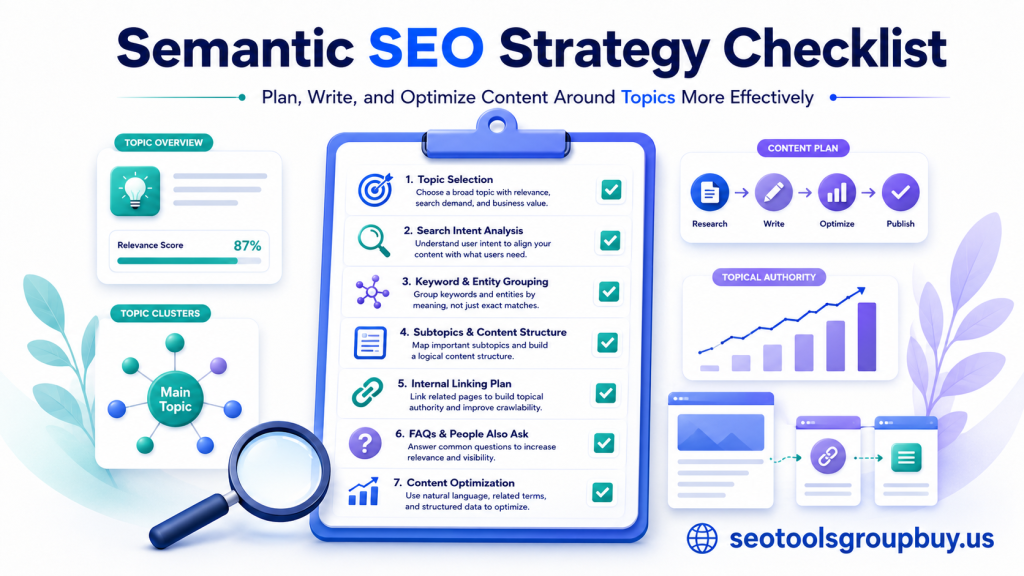
Use this checklist before publishing your article:
- Choose a clear main topic
- Understand the search intent
- Group related keywords by meaning
- Add important subtopics
- Include related entities naturally
- Write clear headings
- Answer common questions
- Add useful examples
- Link to related internal pages
- Use natural anchor text
- Avoid keyword stuffing
- Add a helpful FAQ section
- Review and update the content regularly
Frequently Asked Questions
What is semantic SEO?
Semantic SEO is the process of optimizing content around meaning, context, and topic relationships instead of only targeting exact-match keywords.
Is semantic SEO better than keyword SEO?
Semantic SEO is usually more complete because it focuses on the full topic. However, keyword research is still useful. The best strategy combines keyword research with topic-based content planning.
Do keywords still matter in semantic SEO?
Yes, keywords still matter. They help you understand what people are searching for. But you should use keywords naturally and support them with related subtopics, questions, and entities.
What is a topic cluster?
A topic cluster is a group of related pages connected around one main topic. It usually includes a pillar page and several supporting articles.
What is topical authority?
Topical authority means your website has strong coverage and expertise around a subject. It is built by publishing helpful, connected content on related topics.
How do internal links help semantic SEO?
Internal links connect related pages. They help users find more useful content and help search engines understand the structure and meaning of your website.
How long should a semantic SEO article be?
There is no fixed length. The article should be long enough to fully answer the topic. Some topics need 1,000 words, while others may need 3,000 words or more.
Can semantic SEO help increase traffic?
Yes. A well-structured semantic SEO article can rank for multiple related keywords, answer more user questions, and attract more organic traffic over time.
Final Thoughts
Semantic SEO is not about ignoring keywords. It is about using keywords in a smarter way.
Instead of creating content around one phrase, build content around the complete topic. Understand search intent, cover related subtopics, include important entities, answer real questions, and connect your pages with internal links.
This approach helps users because they get better answers. It also helps search engines understand your website more clearly.
If you want your content to perform better in modern SEO, stop thinking only about keywords. Start thinking about topics, meaning, and user value.
A strong semantic SEO strategy can help your website build authority, rank for more search queries, and become a more trusted resource in your niche.