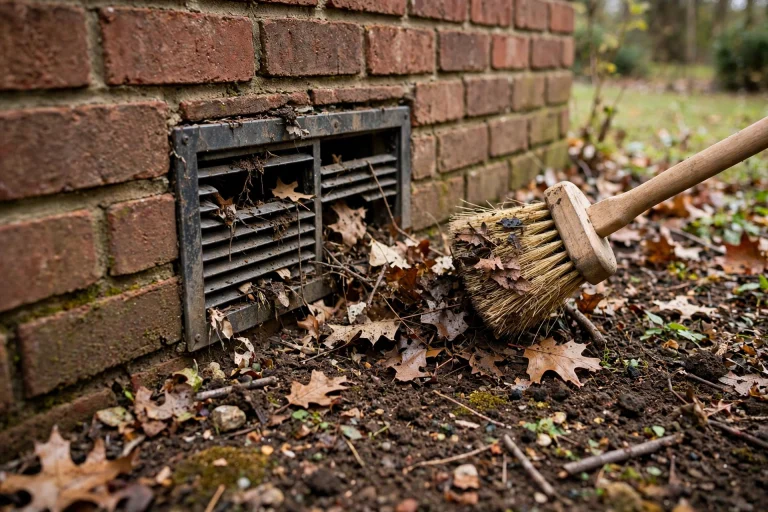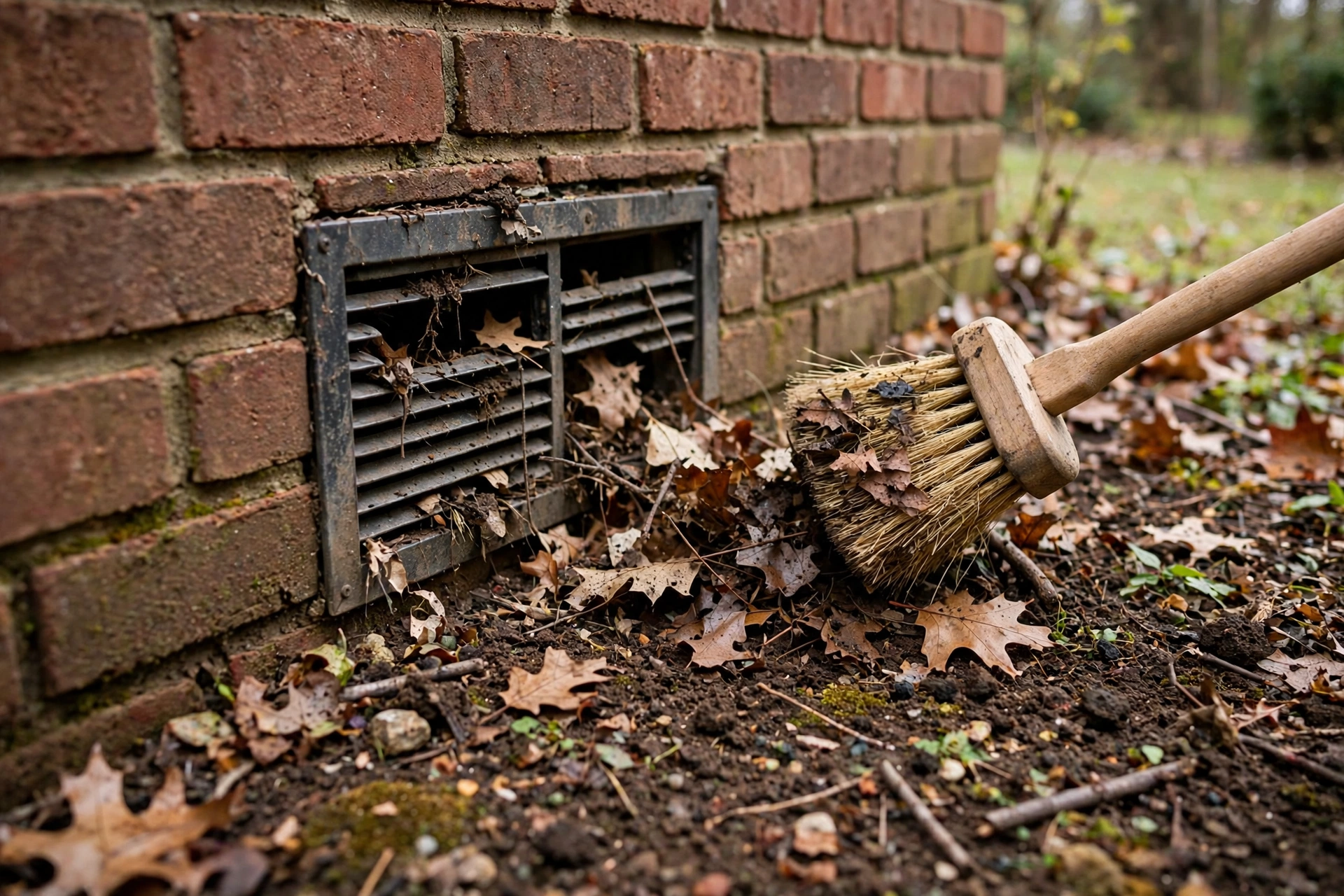
Foundation vents only help your house if they are clean, screened, and managed with the seasons. A vent clogged with leaves, torn by pests, or left open through a humid summer can trap more moisture under your floor than it removes — and damp joists, musty smells, and mould are the price. The good news is that maintaining them is a simple twice-a-year job, and most of it needs nothing more than a brush, a screwdriver, and a look underneath the house.
There is one honest complication worth stating up front: building science has moved on from the old idea that more venting is always better. In hot, humid climates, open vents can pull damp air into a cool crawl space and make condensation worse. This article covers maintaining a vented system properly, and it also tells you when sealing the vents is the better answer.
What follows is the full routine: how the vents work, the seasonal schedule, how to keep screens and pests under control, how to read the warning signs under your floor, and how to decide when venting has done all it can and sealing is the better answer. None of it is difficult. All of it is the kind of maintenance that saves thousands if it happens on time.
What Foundation Vents Do and What They Cannot Fix
Foundation vents are the small openings set into the perimeter wall just above ground level, leading into the crawl space beneath the house. Their original job was simple: let outside air move through the space under the floor, carrying away moisture rising from the soil and diluting soil gases. Building codes required them for most of the twentieth century, and the old rule of thumb was about one square foot of vent opening for every 150 square feet of floor area.
What vents cannot do is fix water. If rain pools against the foundation, if downspouts dump water at the wall, or if a pipe leaks under the floor, no amount of airflow will dry the space out. Vents manage air; they do not manage water. Anyone who tells you otherwise is selling you a vent. Sort the water first, then maintain the vents.
How to Run a Seasonal Routine for Opening and Closing Vents
For a traditional vented crawl space, the vents need managing twice a year, and the timing matters more than the effort. Open them when the weather turns warm and dry so air can move, and close them before the cold arrives so freezing air cannot reach the pipes. In many climates that means open in late spring and closed in late autumn, but watch your own weather rather than a calendar date.
Spring opening: remove the winter covers, check every louver moves freely, and clear leaves and debris from each opening.
Screen check: look at every screen for tears, rust, and gaps at the edges. A torn screen is an open invitation to rodents and insects.
Summer look-in: once mid-summer, check under the house for damp smells, standing water, or new mould on the joists.
Autumn closing: when overnight temperatures start dropping toward freezing, fit the vent covers or close the louvers.
Winter check: after the first hard frost, confirm the covers are seated and no cold draught is reaching the pipes.
After every big storm: check that rain has not driven through the vents and that the ground outside still slopes away from the wall.
The step people forget is the storm check. A vent that faces the prevailing wind can take in surprising amounts of rain during a storm, and a puddle on the ground cover under the house is often the first sign. If you keep finding water after storms, a vent hood or a simple deflector over the opening is a cheap fix.
Cleaning Screens and Keeping Pests Out
The screen is the part of the vent that does the most work and gets the least attention. Its job is to let air through while keeping out mice, rats, snakes, and insects, and it fails quietly — a small tear or a rusted corner is all a mouse needs. Once pests get in, they nest in insulation, chew wiring, and leave droppings that make the air under your floor genuinely unhealthy.
- Brush each screen clean with a stiff brush every spring; dust and cobwebs cut airflow more than you would expect.
- Replace torn mesh immediately — use galvanised or stainless steel mesh, never plastic, which rodents chew through.
- Check the frame seal where the vent meets the foundation; gaps here are a second front door for pests.
- Trim plants back at least 30 centimetres from every vent so air can move and pests have no cover.
- Look for droppings and nesting material during the screen check — early signs of entry are far easier to fix than an established nest.
- Fit a vent hood on windward openings to stop wind-driven rain without blocking airflow.
One practical tip: keep a spare piece of mesh and a few screws in the garage. When you find a torn screen, you can fix it the same day instead of adding it to a list that never gets done. A vent left open to pests for a season is how a small repair becomes an exterminator’s bill.
Reading the Warning Signs Under Your Floor
The space under your house talks to you, if you know what to look for. A healthy crawl space smells like nothing much, has dry joists, a clean ground cover, and very few cobwebs. Anything else is a message, and the table below translates the common ones.
| What you find | Likely cause | What to do |
|---|---|---|
| Musty smell | High humidity, early mould | Check vents, add ground cover |
| Standing water | Rain or leak getting in | Fix grading, check pipes |
| White powder on joists | Mould or mineral salts | Dry the space, test humidity |
| Sagging insulation | Damp insulation falling | Replace, fix moisture source |
| Lots of cobwebs | Humid, still air | Improve airflow or dehumidify |
| Rodent droppings | Torn screen or gap | Repair screen, seal entry points |
If you find a puddle, play detective before you mop it up. Grey, filmy water usually means a sink or washing machine drain is leaking — run each fixture and watch. Clear water after rain usually means it came through a vent or over the foundation wall. Toilet-smelling water is a different problem entirely and needs a plumber immediately.
When Open Vents Make Moisture Worse
Here is the part the old advice gets wrong. In a warm, humid climate, the air outside your house can hold far more moisture than the cool air under your floor. When that hot, damp air flows through an open vent and hits cool joists, ductwork, and the ground, it cools — and cooling air drops its moisture as condensation. The relative humidity under the floor can climb above 70 percent, which is exactly the range where mould and wood-decay fungi thrive.
This is why the same venting advice does not work everywhere. In a dry climate, open vents usually help. In a humid summer climate, they can actively hurt. If your crawl space stays damp all summer despite clean, open vents, the vents are not the solution — they may be part of the problem, and sealing them is worth considering seriously.
You can test this yourself with a cheap hygrometer. Put one in the crawl space and one outside on a humid summer day. If the crawl space reads higher than the outside air, the vents are importing moisture rather than removing it. That single reading tells you more about your house than any general rule ever will, and it is the evidence that should drive the decision to seal or to keep venting.
Ground Cover and Grading: the Other Half of the Job
Vents manage air, but the ground under your house is the biggest source of moisture in the first place. Bare soil constantly releases water vapour into the crawl space. A 6-mil black plastic ground cover, laid tightly over the soil, overlapped at the seams, and anchored at the edges, cuts that source dramatically — it is the single most effective cheap fix in crawl space work.
Outside, the ground should slope away from the foundation for at least the first two metres, and downspouts should discharge water well away from the wall. A splash block or a pipe that carries roof water three metres from the house does more for under-floor moisture than any vent ever will. Check the grading every year, because soil settles and mulch builds up against the wall over time.
While you are outside, look at the vents themselves in relation to the ground. A vent that sits below the soil line after years of mulch and settled earth is not a vent at all — it is a hole that lets water in. The bottom of each vent should sit clearly above the finished ground level, with the soil sloping away from it. If mulch has crept up over a vent, pull it back and re-grade that spot before the next rain.
Vapour Barriers and Dehumidifiers: When Vents Need Help
Sometimes vents alone are not enough, and the next step is not more vents — it is taking the moisture out at the source. A heavy ground vapour barrier does the heavy lifting: a 20-mil reinforced polyethylene sheet, laid across the whole crawl space floor and run up the walls to the sill plate, sealed at the seams and edges, cuts ground moisture dramatically. The thin 6-mil plastic many homes have is better than nothing, but the heavier reinforced material lasts and seals far better.
A dehumidifier is the second half of the pair. A dedicated crawl space dehumidifier, set to hold the space around 50 to 55 percent relative humidity and drained to the outside or a sump, keeps the air dry even when the vents are closed. It costs money to run, but far less than replacing rotted joists. If your crawl space stays damp with clean vents and a good ground cover, a vapour barrier plus a dehumidifier is usually the answer.
Deciding Whether to Seal Vents and Encapsulate
Modern building science increasingly favours sealing foundation vents entirely and encapsulating the crawl space: close every vent with rigid foam and sealant, run a heavy vapour barrier up the walls, and condition the space with a dehumidifier or a small supply of conditioned air. In humid climates this usually controls moisture far better than venting ever did.
It is not a small job, and it is not right for every house. It costs real money, it needs the ground cover and drainage sorted first, and it should be done by someone who understands crawl space work. But if you have maintained your vents properly and the space under your floor is still damp every summer, encapsulation is the honest next step — not another vent, and not more airflow.
Before you commit, get the space properly assessed — a moisture reading on the joists, a check for existing mould or rot, and a look at how water reaches the foundation. Encapsulating a crawl space that already has rot or a plumbing leak just seals the problem in. Fix the water, fix the wood, then seal. Done in that order, encapsulation is one of the best investments you can make in an older home.
Foundation Vent Maintenance Questions Homeowners Ask
Should foundation vents be open or closed in summer?
In dry climates, open them in summer for airflow. In hot, humid climates, open vents can pull damp air into a cool crawl space and cause condensation, so many homeowners there keep them closed and control humidity with a vapour barrier and dehumidifier instead. Your climate decides, not a general rule.
How often should I clean foundation vent screens?
At least twice a year — when you open the vents in spring and when you close them in autumn. Brush off dust and cobwebs, check for tears and rust, and replace damaged mesh immediately. A torn screen is an open door for rodents.
How much venting does a crawl space need?
The traditional rule is about one square foot of vent opening for every 150 square feet of floor area, with vents placed at corners and spaced evenly around the foundation. Modern guidance varies by climate, and sealed crawl spaces need no vents at all.
Why does my crawl space smell musty even with vents?
A musty smell usually means the humidity under the floor is too high for the airflow to handle. Check for standing water, bare soil without a ground cover, and blocked vents. If the vents are clean and open and the smell persists, the moisture source is bigger than ventilation can fix.
Can I seal my foundation vents permanently?
Yes, and in humid climates it is often the better approach. Seal the openings with rigid foam board and caulk, install a heavy ground vapour barrier, and control humidity with a dehumidifier. Sort drainage and grading first, and consider a professional for the encapsulation work.
Final Thoughts on Foundation Vents and a Dry Floor
Foundation vents are a small part of a dry house, but they are a part that rewards attention. Clean the screens, manage them with the seasons, keep the ground covered and the grading right, and check underneath twice a year. And if the space stays damp no matter how well you maintain the vents, trust what you are seeing — in a humid climate, sealing them may be the right answer after all.